
Ashwagandha is an Ayurvedic herb that, in a number of small clinical trials, has reduced perceived stress, lowered cortisol and modestly improved sleep. Most studies use 250–600 mg a day of root extract for six to eight weeks. However, it is not suitable for everyone: it has been linked to rare liver injury, can affect thyroid hormone levels, and should be avoided in pregnancy.
Key takeaways
- Ashwagandha (Withania somnifera) is a nightshade-family shrub whose root is used in Ayurveda.
- It is classed as an adaptogen – a herb said to help the body cope with stress.
- Trials show reductions in stress scores and cortisol; evidence for sleep is modest but positive.
- Typical dose: 250–600 mg/day of standardised root extract.
- Avoid in pregnancy, with thyroid or autoimmune conditions, or with liver disease unless advised by a doctor.
What is ashwagandha?
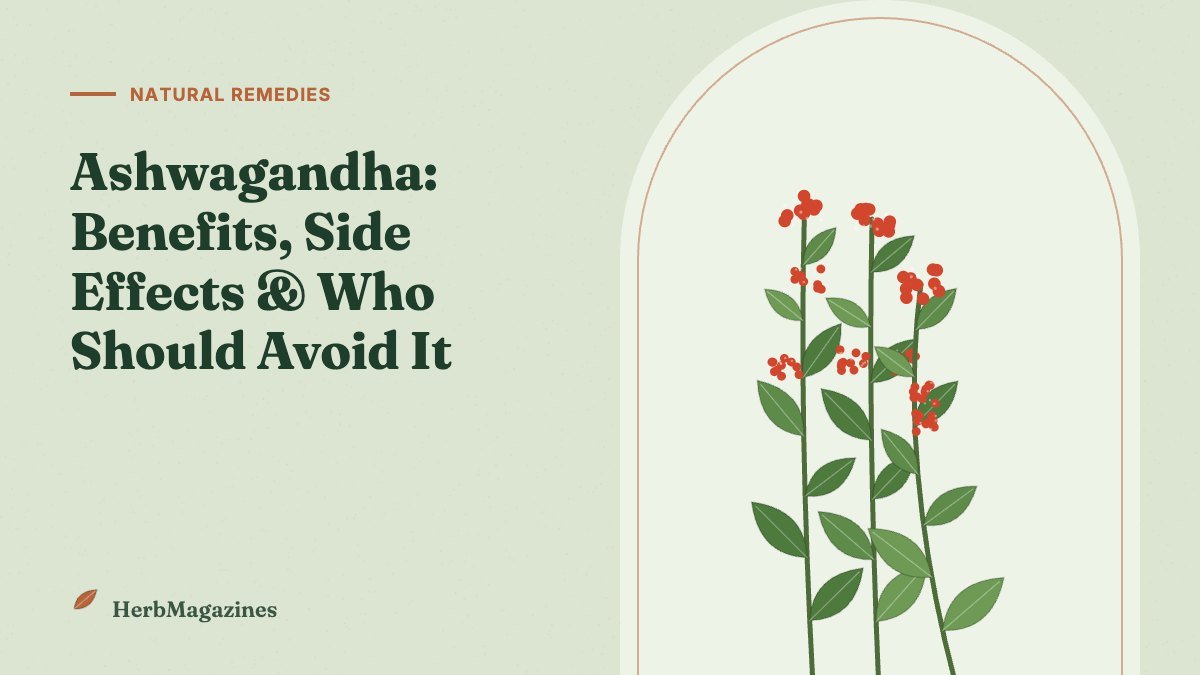
Ashwagandha (Withania somnifera), also called Indian ginseng or winter cherry, is a small evergreen shrub native to India, the Middle East and parts of Africa. Its name comes from Sanskrit and roughly means “smell of the horse”, referring both to the root’s earthy odour and the traditional belief that it gives the strength of a horse. It belongs to the nightshade family, alongside tomatoes and potatoes, and produces small orange-red berries inside papery husks.
In Ayurveda it has been used for more than 3,000 years as a rasayana – a rejuvenating tonic. Its main active compounds are withanolides, steroidal lactones that most supplements are standardised to.
What does the research show?
| Benefit | Evidence | Notes |
|---|---|---|
| Stress and anxiety | Moderate | Several randomised trials show lower stress scores and cortisol versus placebo |
| Sleep | Moderate | A 2021 meta-analysis found small but significant improvements in overall sleep |
| Exercise performance | Limited–moderate | Some gains in strength and VO2 max in small trials |
| Male fertility | Limited | Improvements in sperm parameters in small studies |
| Thyroid function | Limited | May raise thyroid hormone levels – a benefit or a risk depending on the person |
| Memory and focus | Early | A few small trials with positive results |
Stress and cortisol
In one frequently cited trial, adults with chronic stress taking 600 mg of root extract daily for 60 days had substantially lower stress-scale scores and serum cortisol than those on placebo. Later trials using 240–300 mg doses showed similar directions of effect. Most trials are small, short and funded by supplement manufacturers, so the findings should be treated as promising rather than conclusive. For other calming herbs, see our guide to herbs for anxiety.
Sleep
The species name somnifera means “sleep-inducing”. A systematic review and meta-analysis found ashwagandha improved overall sleep quality, particularly in people with insomnia and at doses of 600 mg or more for at least eight weeks.
How to take ashwagandha
- Capsules or tablets of standardised root extract (often KSM-66 or Sensoril) are the most studied form.
- Powder can be stirred into warm milk with honey and cardamom, the traditional “moon milk”.
- Take it consistently; benefits in trials appeared after four to eight weeks.
- Many people take it in the evening because of its potential to aid sleep.
Side effects and safety concerns
Ashwagandha is generally well tolerated in short-term studies, but there are important safety signals:
- Liver injury: dozens of cases of liver damage linked to ashwagandha supplements have been reported worldwide. In 2023, Denmark’s food authority moved to ban ashwagandha products, and the UK Food Standards Agency and Committee on Toxicity have reviewed its safety.
- Thyroid: it can increase thyroid hormone levels. Avoid with hyperthyroidism and use only under supervision with thyroid medication.
- Pregnancy: traditionally believed to have abortifacient properties at high doses – avoid entirely.
- Autoimmune diseases: it may stimulate the immune system; caution with lupus, rheumatoid arthritis or MS.
- Medication interactions: possible additive effects with sedatives, thyroid hormones, immunosuppressants, and drugs for diabetes and blood pressure.
- Common mild effects: drowsiness, stomach upset, diarrhoea and nausea.
Who should avoid ashwagandha?
- People who are pregnant, trying to conceive or breastfeeding.
- Anyone with liver disease or a history of liver problems.
- People with hyperthyroidism or on thyroid medication (unless supervised).
- People with autoimmune conditions.
- Anyone due to have surgery within two weeks.
- People with nightshade allergies.
The bottom line
Ashwagandha has more clinical data behind it than most adaptogens, and it may help with stress and sleep. But it is a biologically active herb with real risks. Buy from reputable brands with third-party testing, use it for limited periods, and speak to your GP or pharmacist first – especially if you take any regular medication. If you prefer a gentler approach, try holy basil (tulsi) tea or lemon balm.
Frequently asked questions
How long does ashwagandha take to work?
In clinical trials, effects on stress and sleep were typically measured after four to eight weeks of daily use. Some people report feeling calmer sooner.
Is ashwagandha safe to take every day?
Short-term daily use (up to around three months) appears safe for most healthy adults in studies. Long-term safety is less clear, and rare liver injury has been reported, so take breaks and consult a professional.
Should I take ashwagandha in the morning or at night?
Either works. Many people take it in the evening because it may promote sleep, but taking it at the same time each day is more important than the exact time.
Can ashwagandha affect the thyroid?
Yes. Ashwagandha can raise thyroid hormone levels. People with hyperthyroidism or those taking thyroid medication should avoid it or use it only under medical supervision.
Is ashwagandha banned anywhere?
Denmark moved to ban ashwagandha products in 2023 over safety concerns, and other regulators have reviewed it. It remains widely sold in the UK and US.
Sources and further reading
- NCCIH – Ashwagandha
- Chandrasekhar K et al. (2012) A prospective, randomized double-blind, placebo-controlled study of safety and efficacy of a high-concentration full-spectrum extract of ashwagandha root in reducing stress and anxiety in adults. Indian Journal of Psychological Medicine.
- Cheah KL et al. (2021) Effect of Ashwagandha (Withania somnifera) extract on sleep: a systematic review and meta-analysis. PLOS ONE.