
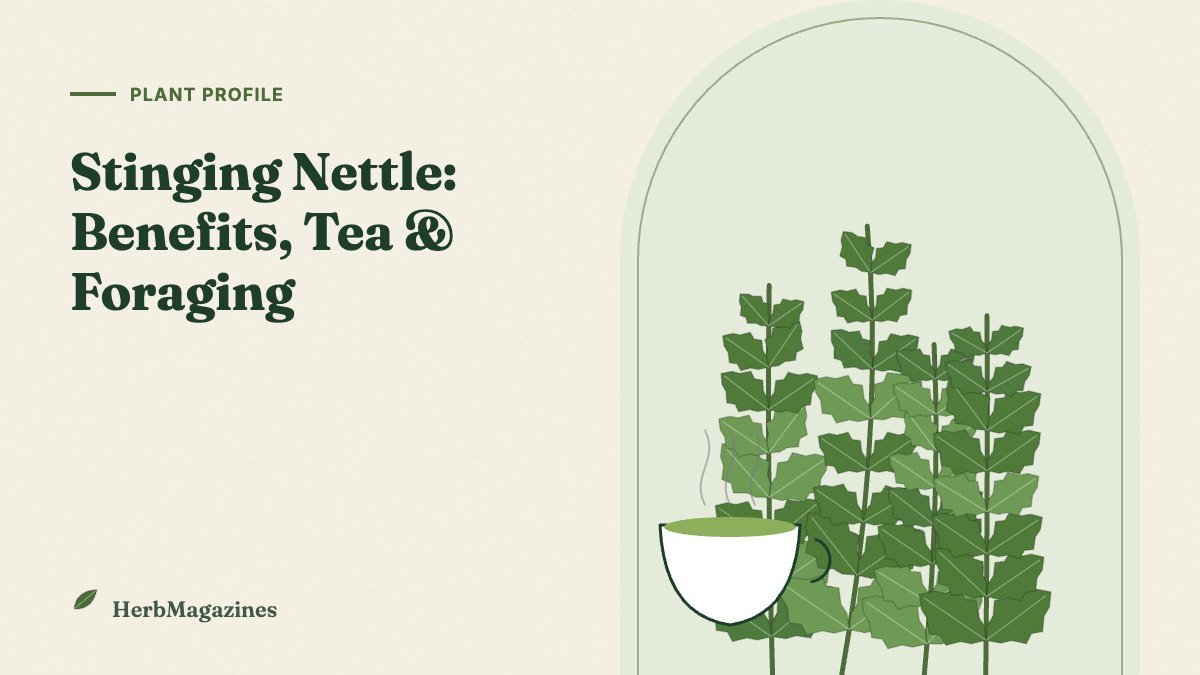
Stinging nettle (Urtica dioica) is a common wild plant across the UK and US whose young leaves are a nutritious spring green and whose leaf and root are used in herbal medicine. Small studies suggest nettle may modestly help hay fever, joint pain and urinary symptoms of an enlarged prostate. Cooking or drying the leaves completely neutralises the sting, making nettle tea and soup safe and delicious.
Key takeaways
- Nettle stings come from hollow hairs that inject histamine, acetylcholine, serotonin and formic acid.
- Young leaves are rich in vitamin K, calcium, iron and protein.
- Nettle root has the best evidence, for benign prostatic hyperplasia (BPH) symptoms.
- Harvest the top 4–6 leaves of young plants before flowering, wearing gloves.
- Check with a doctor if you take blood thinners, diuretics, lithium or diabetes medicines.
Why do nettles sting?
Nettle leaves and stems are covered in tiny hollow hairs called trichomes, each tipped with a brittle silica bulb. When brushed, the tip snaps off, leaving a needle-like point that injects a cocktail of histamine, acetylcholine, serotonin, formic acid and oxalic and tartaric acids. The result is the familiar burning, itching bumps. Traditional relief includes dock leaves (more placebo than proven), cold water and antihistamine cream.
Nettle through history
Nettles have been used for at least 2,000 years. Bronze Age people wove nettle fibre into cloth, and during the First World War German army uniforms were made partly from nettle fibre when cotton was scarce. Roman soldiers are said to have rubbed nettles on their limbs to keep warm in Britain’s cold climate, and “urtication” – deliberately stinging joints – was a folk remedy for arthritis.
Nutrition
Cooked young nettle leaves are surprisingly nutritious, providing:
- Vitamin K, vitamin A (as carotenoids) and some vitamin C
- Calcium, iron, magnesium and potassium
- Around 2–3 g of protein per 100 g cooked, high for a leafy green
What does the research say?
| Use | Part used | Evidence |
|---|---|---|
| Enlarged prostate (BPH) urinary symptoms | Root | Moderate – several trials show improved urinary flow and symptom scores, often combined with saw palmetto |
| Osteoarthritis pain | Leaf (topical or oral) | Limited – small trials show reduced pain with leaf application or extract |
| Hay fever (allergic rhinitis) | Leaf (freeze-dried) | Limited – one small 1990 trial plus lab studies on histamine pathways |
| Blood sugar | Leaf | Early – small trials in type 2 diabetes |
| Diuretic (“water tablet”) | Leaf | Traditional; recognised by the European Medicines Agency |
Hay fever
Nettle is popular among UK hay fever sufferers. Lab studies suggest nettle extract can block histamine receptors and inhibit mast cell release, and an early trial found freeze-dried nettle leaf rated slightly better than placebo. It is worth trying, but the evidence is thin compared with antihistamines.
Prostate health
Nettle root extract, sometimes combined with saw palmetto, improved lower urinary tract symptoms in men with BPH in several randomised trials. See a doctor before self-treating urinary symptoms to rule out other conditions.
How to forage nettles safely
- When: early spring (March–May in the UK; spring in most of the US), before flowering. Older plants develop gritty cystoliths that can irritate the kidneys and taste unpleasant.
- What: pick only the top 4–6 leaves of young plants.
- Where: away from roadsides, dog-walking paths and sprayed fields. Nettles love nitrogen-rich ground, so avoid land near livestock runoff.
- How: wear gloves and long sleeves, and use scissors.
- Identify: nettles have opposite, heart-shaped, serrated leaves and square stems covered in fine stinging hairs. Note that dead-nettles (Lamium) look similar but do not sting – they are also edible.
How to make nettle tea
- Fresh: a handful of young tops in a pot of just-boiled water; steep 5–10 minutes.
- Dried: 1–2 teaspoons per cup, steep 10 minutes.
The flavour is green and grassy, a little like spinach. It blends well with mint, lemon balm or peppermint. Learn how to preserve your harvest in how to dry fresh herbs.
Simple nettle soup
Soften an onion and a diced potato in butter, add 1 litre of vegetable stock and simmer for 15 minutes. Add a colander full (about 150 g) of washed nettle tops and cook for 2–3 minutes. Blend, season, and finish with a swirl of cream or crème fraîche. Blanching takes the sting out instantly.
Safety and interactions
- Blood thinners: nettle leaf is high in vitamin K and may counteract warfarin.
- Diuretics and lithium: nettle’s diuretic effect may alter fluid balance and lithium levels.
- Diabetes and blood-pressure medicines: possible additive effects.
- Pregnancy: avoid medicinal amounts; traditionally believed to stimulate the uterus.
- Raw nettles will sting – always cook, dry or blend them thoroughly.
Nettles in the garden
Leave a wild patch if you can: nettles are a key food plant for the caterpillars of red admiral, peacock, comma and small tortoiseshell butterflies in the UK. Nettle “tea” (leaves soaked in water for a few weeks) also makes a nitrogen-rich liquid plant feed. See companion planting with herbs for more wildlife-friendly ideas.
Frequently asked questions
Is nettle tea good for you?
Nettle tea is a mineral-rich, caffeine-free drink that has traditionally been used as a mild diuretic and for hay fever. Research is limited but promising for some uses.
Does cooking nettles remove the sting?
Yes. Cooking, blanching, drying or blending nettles thoroughly destroys the stinging hairs, making them safe to eat.
Can nettle help with hay fever?
Some people find nettle helpful for hay fever, and lab studies show anti-histamine effects, but human evidence is limited to small studies.
When should you pick nettles?
Pick young nettle tops in early spring before the plants flower. Older nettles become tough and gritty.
Who should not drink nettle tea?
People taking blood thinners, diuretics, lithium, or diabetes and blood-pressure medication, and those who are pregnant, should speak to a doctor before using nettle regularly.
Sources and further reading
- NCCIH – Stinging Nettle
- Mittman P (1990) Randomized, double-blind study of freeze-dried Urtica dioica in the treatment of allergic rhinitis. Planta Medica.
- Butterfly Conservation – Gardening for butterflies