
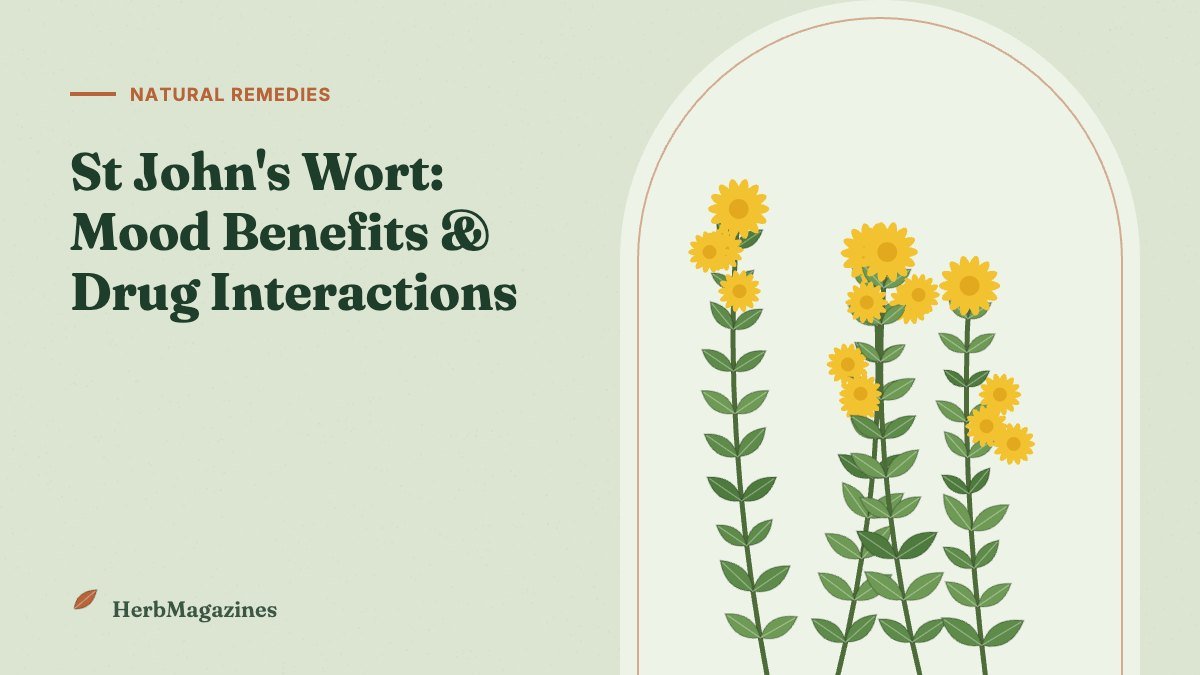
St John’s wort (Hypericum perforatum) has been shown in many clinical trials to work better than placebo – and about as well as standard antidepressants – for mild-to-moderate depression. However, it interacts dangerously with a long list of medicines, including the contraceptive pill, SSRIs, warfarin, HIV drugs and transplant medication. It should only be used after speaking to a doctor or pharmacist.
Key takeaways
- A 2008 Cochrane review of 29 trials found St John’s wort superior to placebo and similar to standard antidepressants for mild-to-moderate depression.
- It induces liver enzymes (CYP3A4) and P-glycoprotein, lowering levels of many medicines.
- It can make the contraceptive pill, implant and emergency contraception less effective.
- Combining it with SSRIs or triptans risks serotonin syndrome.
- It is not appropriate for severe depression; seek professional help.
What is St John’s wort?
St John’s wort is a yellow-flowered perennial native to Europe and Asia that has spread widely across North America, where it is sometimes called Klamath weed. Its name comes from its flowering around St John the Baptist’s feast day on 24 June. Hold a leaf up to the light and you will see tiny translucent dots – oil glands that give the species name perforatum. Crushing the flowers releases a red pigment, hypericin.
In Germany, St John’s wort has long been widely prescribed for depression. In the UK it is sold as a THR-registered herbal medicine, and in the US as a dietary supplement.
Active compounds
- Hyperforin – thought to be the main antidepressant compound; inhibits reuptake of serotonin, noradrenaline and dopamine.
- Hypericin and pseudohypericin – red pigments; responsible for photosensitivity.
- Flavonoids – such as quercetin and rutin.
Evidence for depression
| Evidence | Finding |
|---|---|
| Cochrane review (Linde et al., 2008; 29 trials, 5,489 patients) | More effective than placebo; similar to standard antidepressants with fewer side effects |
| Later meta-analyses (e.g. Ng et al., 2017) | Confirmed benefit for mild-to-moderate depression |
| Severe depression | Not established – not recommended |
| Results by country | Trials from German-speaking countries showed larger effects than those elsewhere |
The UK’s NICE guidelines note that while there is some evidence of benefit, practitioners should not prescribe or advise its use because of uncertainty about appropriate doses, variation between preparations and potential serious interactions. This is a key reason to involve a professional.
The interaction problem
St John’s wort switches on liver enzymes (especially CYP3A4) and a drug-pump protein (P-glycoprotein) that clear medicines from the body. As a result, many drugs become less effective.
| Medicine | Possible consequence |
|---|---|
| Combined pill, progestogen pill, implant, emergency contraception | Reduced effectiveness – risk of unplanned pregnancy |
| SSRIs, SNRIs, triptans, tramadol | Serotonin syndrome (agitation, sweating, fever, tremor) |
| Warfarin | Reduced anticoagulant effect – clot risk |
| Ciclosporin, tacrolimus | Organ transplant rejection |
| HIV protease inhibitors and NNRTIs | Treatment failure |
| Digoxin | Reduced levels |
| Some anti-epileptics, statins, chemotherapy drugs | Reduced effectiveness |
Stopping St John’s wort suddenly while on these drugs can also cause levels to rise sharply. Always tell your doctor, pharmacist and surgeon if you take it.
Other uses
- Menopausal mood symptoms: some trials combined with black cohosh.
- Seasonal affective disorder: limited evidence.
- Topical oil: “red oil” infused in olive oil is traditionally used on minor burns, bruises and nerve pain, but evidence is limited.
Side effects
- Photosensitivity: increased risk of sunburn and rashes, especially in fair-skinned people at high doses.
- Dry mouth, dizziness, stomach upset, fatigue and restlessness.
- Can trigger mania in people with bipolar disorder.
Who should not take St John’s wort
- Anyone taking any prescription medicine without checking with a pharmacist first.
- People using hormonal contraception.
- Those with bipolar disorder or severe depression.
- Pregnant or breastfeeding women.
- People due to have surgery or anaesthesia.
If you are feeling low
Depression is common and treatable. Talk to your GP or doctor, who can discuss talking therapies, exercise programmes and medication. In the UK you can self-refer to NHS Talking Therapies; in the US, call or text 988 for the Suicide & Crisis Lifeline. For gentler calming herbs, see herbs for anxiety.
Frequently asked questions
Does St John’s wort really work for depression?
Clinical trials and a Cochrane review found St John’s wort more effective than placebo and similar to standard antidepressants for mild-to-moderate depression, but not for severe depression.
Can I take St John’s wort with the pill?
No, not without medical advice. St John’s wort can make hormonal contraception, including the pill and implant, less effective, increasing the risk of pregnancy.
How long does St John’s wort take to work?
In trials, improvements in mood typically appeared after four to six weeks of daily use.
Can St John’s wort be taken with sertraline or other SSRIs?
No. Combining St John’s wort with SSRIs can cause serotonin syndrome, a potentially dangerous condition.
Does St John’s wort make you sensitive to the sun?
Yes. Hypericin can increase photosensitivity, raising the risk of sunburn and skin rashes, particularly at high doses.
Sources and further reading
- Linde K et al. (2008) St John’s wort for major depression. Cochrane Database of Systematic Reviews.
- NCCIH – St. John’s Wort
- NHS – St John’s wort (depression treatment)